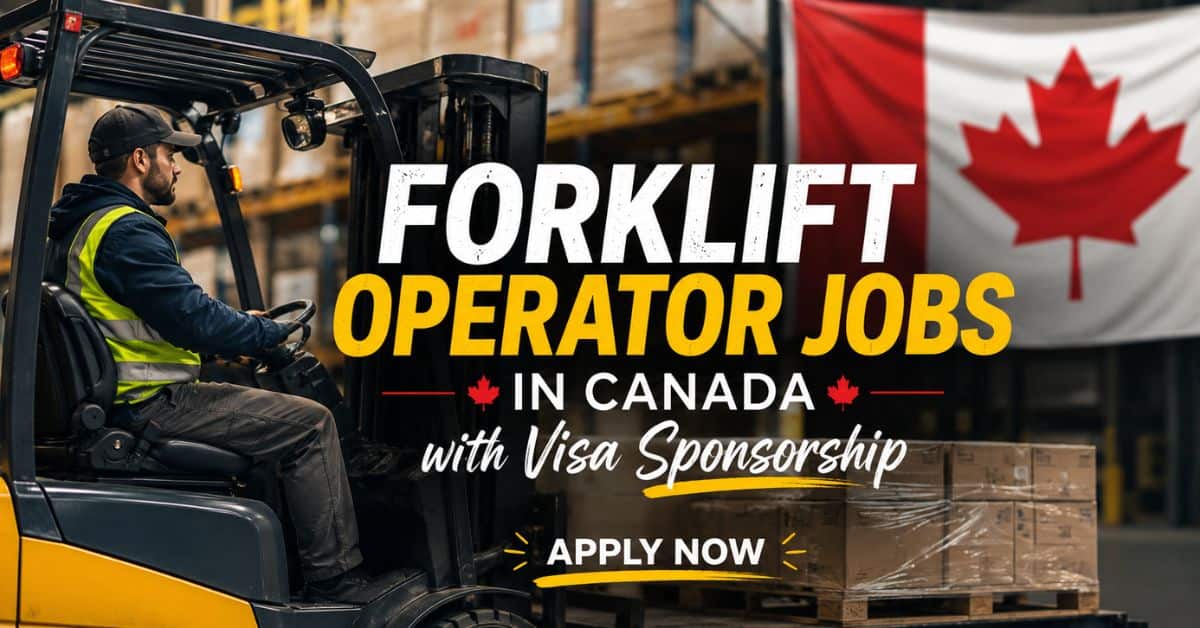
Forklift operator roles in Canada typically pay around CAD 20–30 per hour, usually require 1–2 years of warehouse experience, are fully physical on-site positions, and are offered as full-time jobs with overtime opportunities. For many workers, these numbers are more than just statistics.
They represent a real chance to step into a stable career abroad, support family back home, and build a better financial future. Canada’s logistics industry has become one of the most reliable entry points for international workers who want steady employment and long-term growth.
Why Canada Needs Forklift Operators?
Before getting into applications and visas, it’s important to understand the “why” behind the demand. Canada is not just short on workers; it is also short on certain workers, and forklift operators fall clearly into that category.
The country’s storage and transportation industries have expanded in tandem with e-commerce growth. Forklift operators are essential to the smooth running of major fulfillment hubs, cold storage facilities, manufacturing factories, and retail distribution centers. Meanwhile, an aging domestic workforce implies that retirements outnumber new entrants into the sector.
As Canadian firms expand their supply chains, the logistics industry has developed, producing additional jobs in warehouses and distribution facilities. Canada’s manufacturing and industrial industries also rely on forklift operators to handle raw materials and completed goods.
The result: a consistent and structural shortage that makes international recruitment not just acceptable, but actively encouraged by the Canadian government through its Temporary Foreign Worker Program (TFWP).
What Does a Forklift Operator Do in Canada?
The role itself is consistent whether you are working in Mississauga, Calgary, or Vancouver. Core responsibilities include:
- Loading and unloading cargo from trucks and containers
- Moving products across warehouses, distribution hubs, and factory floors
- Operating equipment such as counterbalance forklifts, reach trucks, swing-reach forklifts, pallet jacks, and stand-up straddle trucks.
- Performing pre- and post-shift safety inspections on all equipment
- Keeping accurate inventory records with RF scanners or warehouse management systems (WMS)
- Following the WHMIS (Workplace Hazardous Materials Information System) and provincial safety standards
- Reporting equipment failures, damaged products, and workplace risks
Workers gain exposure to Canada’s advanced warehouse technologies, automated systems, and safety processes used in Canada’s top-notch supply chain and logistics operations.
Check Also: Truck Driving Jobs in Canada with Visa Sponsorship
How Much Do Forklift Operators Earn in Canada?
Salary is one of the most compelling factors for overseas applicants. Forklift operators in Canada get competitive pay that rise with experience, certifications, and location.
Forklift operators in Canada typically make between CAD 20 and CAD 30 per hour, depending on experience, region, and company size, with potential for overtime and professional growth in logistics.
Here’s a province wage breakdown to help you figure out where your earnings might land:
| Province | Average Hourly Rate (CAD) |
|---|---|
| British Columbia | $22 – $28 |
| Alberta | $22 – $30 |
| Ontario | $20 – $26 |
| Quebec | $19 – $25 |
| Saskatchewan | $21 – $27 |
| Manitoba | $19 – $24 |
| Nova Scotia | $18 – $23 |
Hourly remuneration typically varies between CAD 20 and 40 for more experienced or specialist operators, with rates ranging depending on experience, skills, and employer. Certain positions may also include bonuses, overtime pay, and other benefits.
Night shifts, weekend premiums, and overtime can considerably increase your take-home compensation. Some firms additionally provide performance bonuses and compensated relocation assistance to sponsored employees.
Who Is Sponsoring Forklift Operators Right Now?
Amazon Canada, a large e-commerce corporation with multiple fulfillment facilities, frequently employs forklift operators to handle warehouse operations. FedEx Canada, a major player in logistics and courier services, hires forklift operators to manage packages and freight at its distribution centers, with salaries ranging from CAD 18 to CAD 25 per hour. The company is committed to employee development and offers visa sponsorship to qualified foreign workers.
Other prominent employers who aggressively recruit globally include:
- Walmart Canada: distribution centers across Ontario, Alberta, and BC
- Sobeys / Empire Company: retail support centers in Nova Scotia and Ontario
- Overland West Freight Lines: warehouse operations in Western Canada
- Maple Leaf Foods: food manufacturing plants requiring certified operators
- Loblaws / George Weston: distribution hubs across multiple provinces
- Purolator and UPS Canada: national courier network operations
Smaller regional logistics companies and third-party logistics (3PL) providers also frequently sponsor foreign workers, particularly in areas with lower local labor availability.
What Is Visa Sponsorship and How Does It Work?
Visa sponsorship implies that the employer will make a legal job offer, be willing to sponsor your work permit application, and apply for a Labour Market Impact Assessment (LMIA) when needed.
Here’s a step-by-step procedure for most forklift operator roles:
Step 1: Employer Obtains a Positive LMIA
The majority of forklift operator occupations require an employer who has been approved by the LMIA. CUSMA, an international trade agreement for US and Mexican residents, may exempt some jobs from the LMIA. The LMIA is a government document from Employment and Social Development Canada (ESDC) that confirms there was no qualified Canadian or permanent resident available for the post.
Step 2: You Receive a Job Offer
For employer-sponsored employment, the work-permit process normally goes like this: confirm the job offer, determine whether an LMIA is required, complete the employer side (LMIA or Employer Portal submission), and then have the candidate apply for their work visa with IRCC. Only after clearance may they begin working for the Canadian employer.
Step 3: You Apply for a Work Permit
You can apply for a Temporary Foreign Worker Program (TFWP) work permit after receiving a job offer and a positive LMIA. Your permit is employer-specific, meaning it ties you to that particular employer and location initially.
Step 4: Arrival and Work Authorization
Once your permit is approved and you land in Canada, you are legally authorized to begin working. Your employer handles the onboarding, and in many cases, assists with accommodation and local settlement.
What Are the 2026 LMIA Rule Changes You Must Know?
Immigration rules in Canada evolve frequently, and 2026 brings important updates that both applicants and employers need to understand.
As of April 1, 2026, employers submitting a Labour Market Impact Assessment (LMIA) application for low-wage positions must advertise the job offer for a minimum of 8 consecutive weeks in the 3 months before submitting the application. This is doubled from the previous 4-week requirement and means the hiring process takes longer but it also makes approvals more credible once issued.
Filing the wrong stream, submitting a low-wage LMIA when the wage clears the provincial median, or vice versa triggers a re-routing and resets the queue position. Employers offering wages above the provincial median will be processed under the high-wage LMIA stream, which carries fewer restrictions and no TFW hiring caps.
In certain sectors, the cap on the proportion of Temporary Foreign Workers that an employer can hire is capped at 20%. This is an important compliance detail for large distribution centers with multiple sponsored workers.
What Qualifications Do You Need:
Canadian employers and immigration authorities have clear expectations for international forklift operator applicants.
Certifications:
A valid forklift operator certificate, recognized by the industry, confirms your ability to operate forklifts safely and efficiently. Candidates must first have valid work permits or Canadian work status, and applicants may be required to get critical certificates.
If your home-country credential is not directly recognized, some employers and community colleges in Canada provide bridging programs or equivalency examinations. Many companies offer in-house re-certification upon arrival.
Experience:
Applicants must possess a valid forklift license, one to two years of warehouse experience, and awareness of safety protocols. Physical fitness and teamwork abilities are also required for success in this position.
Language:
English proficiency is essential. To grasp safety laws and directions, operators must have excellent communication skills. In Quebec, French language abilities are a significant advantage and frequently required for provincial immigration streams.
Documents Required:
A legitimate offer of employment from a Canadian company, a copy of the job offer letter and LMIA, evidence of work experience ranging from two to three years, certificates of education or training such as operator certification, a currently valid passport, a certificate of police clearance, and a medical examination for some vocations are all typically required.
Which Visa Pathways Are Available for Forklift Operators?
There is more than one route to Canada as a sponsored forklift operator. Understanding your options helps you choose the most strategic path.
- Temporary Foreign Worker Program (TFWP): The primary route. Requires an LMIA from your employer and is valid for up to 2 years (high-wage stream) or 1 year (low-wage stream) with renewal options.
- Provincial Nominee Programs (PNP): Every province runs a TFW-friendly stream. BC PNP, Alberta Advantage Immigration Program, Ontario OINP, Saskatchewan SINP, and Manitoba MPNP all accept TFWP work experience, often including TEER 4 and 5 jobs that the Canadian Experience Class excludes. This is a powerful pathway to permanent residency.
- International Mobility Program (IMP): International trade agreements may exempt certain jobs from the LMIA for example, CUSMA for US and Mexican nationals. If you qualify, this is faster and carries less administrative burden.
- Atlantic Immigration Program (AIP): For those open to Nova Scotia, New Brunswick, Prince Edward Island, or Newfoundland, the AIP offers a streamlined employer-driven pathway with strong permanent residency connections.
How Does Visa Sponsorship Lead to Permanent Residency?
This is the question most international applicants really want answered, and the answer is genuinely optimistic.
The TFWP work visa is only temporary, but the Canadian work experience gained through it feeds directly into the country’s primary permanent residency programs. A worker who obtains an LMIA visa in 2026 has many PR options accessible within 12 to 24 months.
A year of competent Canadian work experience qualifies a person for the Canadian Experience Class inside Express Entry. Most high-wage and global talent stream employees take this route.
Starting as a forklift operator, your career in Canada can take a direct upward route. If you start as a forklift operator, you can advance to supervisory, transportation coordination, or warehouse management jobs, allowing you to improve professionally and personally over time.
Benefits:
- Stable Job Demand: Forklift operator jobs in Canada are consistently in demand because the country’s logistics, warehousing, and e-commerce industries are expanding rapidly. With growing online shopping and supply chain needs, employers are always looking for skilled workers, which creates long-term job stability for both local and international workers.
- Competitive Pay: This role offers solid hourly wages, usually between CAD 20–30 per hour, depending on experience and province. Many companies also provide overtime opportunities, which can significantly increase monthly income. For skilled operators, this makes it a financially rewarding career option.
- Visa Sponsorship Opportunities: Many Canadian employers hire international workers through visa sponsorship programs like the LMIA-based Temporary Foreign Worker Program. This allows qualified candidates to legally work in Canada, making it one of the more accessible pathways for overseas job seekers.
- Career Growth: Starting as a forklift operator can open doors to higher positions such as warehouse supervisor, logistics coordinator, or operations manager. With experience and performance, workers can move into leadership roles within the supply chain industry.
- Permanent Residency Pathway: Work experience gained in Canada can help workers apply for permanent residency through programs like Express Entry or Provincial Nominee Programs. This makes forklift jobs a stepping stone toward long-term settlement in Canada.
- Safe Working Environment: Canadian workplaces follow strict health and safety regulations. Workers receive proper training, use certified equipment, and operate under WHMIS safety standards, ensuring a secure and well-managed environment.
- Skill Development: Operators gain hands-on experience with modern warehouse technology, including advanced forklifts, scanning systems, and automated logistics tools. This improves technical skills and makes workers more valuable in the global job market.
- Relocation Support (in Some Companies): Certain employers assist international hires with relocation support, including onboarding, training, and sometimes temporary accommodation. This helps new workers settle more easily when they arrive in Canada.
Where to Find Forklift Operator Jobs with Visa Sponsorship?
Online job portals such as Indeed, Workopolis, and Job Bank frequently list forklift operator jobs in Canada, and many postings will specify if visa sponsorship is available. Visiting the career pages of major companies like Amazon Canada and Walmart can provide direct access to job openings and application instructions. Specialized recruitment agencies that focus on logistics and warehousing jobs can connect you with Canadian employers offering visa sponsorship.
Additional platforms and resources worth using:
- Canada Job Bank (jobbank.gc.ca), the official government portal, filterable by NOC code and location
- LinkedIn search “forklift operator LMIA” or “forklift Canada visa sponsorship.”
- Workopolis and Monster Canada aggregator sites with logistics-specific filters
- Recruitment agencies specializing in logistics: Adecco Canada, Randstad Canada, and Hays Canada all place foreign workers in warehouse roles
- Provincial nominee program websites list many provinces’ in-demand occupation streams directly
When evaluating job postings, look specifically for language such as “LMIA available,” “visa sponsorship provided,” or “open to international applicants.” If a posting does not mention these terms, you can still inquire directly; many employers will sponsor the right candidate even if it is not explicitly advertised.
Tips to Strengthen Your Application:
The competition for sponsored positions is real. Here is how to position yourself ahead of other candidates:
- Get your forklift qualification recognized: check if your country’s certification has a Canadian equivalency or earn a fresh certificate online through a recognized Canadian training provider.
- Create a Canadian-style resume: one to two pages, no photo, no date of birth, focused on measurable accomplishments and safety records.
- Highlight equipment diversity by listing every type of equipment you have operated: counterbalance, reach truck, order picker, pallet jack, and turret truck.
- Include safety data: accident-free hours, WHMIS training, or other health and safety awards have substantial weight with Canadian companies.
- Improve your English; even a basic IELTS score or confirmation of an English language course strengthens your application significantly.
- Avoid bogus offers; if something seems wrong, speak with a qualified immigration adviser or lawyer. Legitimate Canadian employers supporting visas do not require workers to pay their LMIA or work permit costs ahead.
How to Apply for Forklift Operator Jobs in Canada with Visa Sponsorship?
- Search for job openings on trusted platforms like Canada Job Bank, Indeed, LinkedIn, and official company websites (Amazon Canada, Walmart Canada, logistics firms).
- Look for listings that mention LMIA support or visa sponsorship available.
- Prepare a Canadian-style resume highlighting forklift experience, certifications, and warehouse skills.
- Apply online through job portals or company career pages with a clear and updated profile.
- Attend interviews if shortlisted (online or phone interviews are common).
- If selected, the employer issues a formal job offer and may start the LMIA process.
- After LMIA approval, apply for a Canadian work permit through IRCC.
- Once approved, travel to Canada and begin working with your sponsoring employer legally.
Conclusion:
Forklift operator jobs in Canada offer steady, well-paid work with strong demand driven by logistics growth and labor shortages. With visa sponsorship through LMIA-based work permits, international workers can legally enter and start building experience in Canada. Over time, this role can also open doors to permanent residency and long-term career growth in the country.
Frequently Asked Questions:
1. Do forklift operator jobs in Canada offer visa sponsorship?
Yes, many Canadian employers offer visa sponsorship through the LMIA-based Temporary Foreign Worker Program, especially in logistics and warehouse sectors facing labor shortages.
2. What is the average salary of a forklift operator in Canada?
Forklift operators usually earn between CAD 20–30 per hour, with higher pay possible depending on experience, province, and overtime hours.
3. Do I need experience to apply for forklift jobs in Canada?
Yes, most employers prefer at least 1–2 years of warehouse or forklift operating experience along with valid certification.