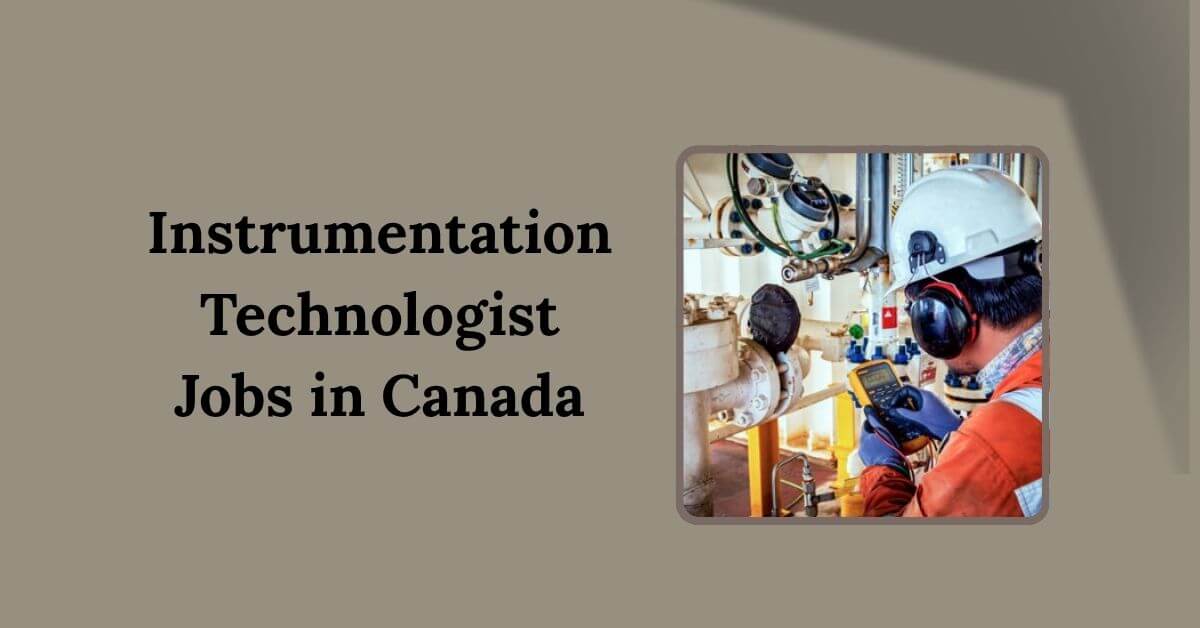
Hamilton, Ontario, is home to Maple Leaf Foods. For the position of Instrumentation Technologist, the organization is currently accepting applications. We are looking for a diligent person with outstanding people skills. The selected candidate must join and start working as soon as possible. Depending on experience, credentials, and the total remuneration package, this position usually pays between CAD $70,000 and $90,000 annually.
Details of Instrumentation Technologist Job:
- Employer Name: Maple Leaf Foods
- Position: Instrumentation Technologist
- Annual Salary: $70,000 to $90,000 per year
- Location: Hamilton, ON
Job Description:
- Instruments used to measure and control flow, level, pressure, temperature, chemical composition, and other factors in manufacturing and processing must have their testing and maintenance protocols determined by the applicant.
- The applicant must contribute to troubleshooting, predictive and preventative maintenance, and equipment installation.
- By performing efficient planned maintenance and promptly addressing equipment repair concerns, the applicant will be expected to increase yield.
- Sensors, transmitters, programmable logic controllers, and other system components must be repaired and adjusted by the candidate, or faulty parts must be removed and replaced.
- Plant electricians must receive training and instrumentation support from the candidate.
- When it comes to equipment upgrades, the candidate will have to collaborate closely with the engineering department.
- When starting new programs, the candidate must assist all departments.
- When new equipment enters the plant, the applicant is responsible for maintaining the parts lists and plant control specifications.
- For equipment modifications, the candidate must create electrical schematics in AutoCAD format.
- Calibration records and processes must be accurately documented by the candidate.
- A vital spare parts list for all essential equipment must be created and kept up to date by the candidate.
- Installing control and measurement equipment on both new and old plant machinery and procedures is a must for the candidate.
- When necessary, the candidate must support plant equipment.
Requirements for Instrumentation Technologist Jobs in Canada:
- The applicant must exhibit a complete dedication to putting the Global Standard for Food Safety’s criteria into practice as well as procedures that support ongoing advancements in food safety and quality control.
- The applicant must have at least five years of relevant experience in a manufacturing setting, ideally one that uses lean manufacturing techniques.
- The applicant must have a thorough understanding of process control systems and be able to read and edit PLC and HMI programming.
- In addition to having solid working knowledge of other control systems, like Siemens, the candidate must possess specialized competence in Allen-Bradley PLC logic.
- The applicant must approach troubleshooting logically.
- The applicant must be a forward-thinking team member who places a high priority on ongoing development.
Check Also: Machinist Jobs in Canada – Apply Now
Entry Level Instrumentation Technologist Jobs Canada:
Instrumentation Technologist at Entry Level: Candidates starting their careers in process control, automation, and industrial instrumentation should apply to Jobs Canada. These experts usually help senior employees with instrument and control equipment installation, testing, calibration, maintenance, and troubleshooting. Candidates may be eligible for entry-level positions with a technical diploma in instrumentation technology or a similar discipline. To begin a career in this industry, one must possess strong attention to detail, safety awareness, basic electrical knowledge, and a willingness to learn.
Junior Instrumentation Technologist Jobs Canada:
Developing professionals can obtain hands-on experience with industrial measurement and control systems through Junior Instrumentation Technologist Jobs Canada. Junior technologists can help with testing, calibration, equipment inspections, troubleshooting, documentation, and preventative maintenance. They frequently collaborate with maintenance teams, engineers, electricians, and senior technicians. Junior professionals can enhance their understanding of sensors, transmitters, control valves, automation equipment, and industrial process-control systems through practical experience.
Senior Instrumentation Technologist Jobs Canada:
Jobs for Senior Instrumentation Technologists in Canada are intended for seasoned experts who are capable of handling challenging instrumentation and control-system duties. Senior technologists may be in charge of technical projects, equipment upgrades, maintenance plans, calibration, commissioning, and troubleshooting. They might also work with the engineering and operations teams and mentor less experienced staff members. Candidates may be eligible for senior roles if they have several years of industrial experience, strong technical knowledge, leadership qualities, and problem-solving abilities.
Instrumentation and Controls Technologist Jobs Canada:
Technologist for Instrumentation and Controls Jobs Canada integrates automation, process control, and industrial instrumentation. Experts in these roles contribute to the accurate and dependable operation of sensors, measuring devices, control systems, and automated equipment. Working with PLCs, control valves, transmitters, process-control systems, electrical controls, calibration equipment, and industrial automation technologies may be part of the job, depending on the company. Manufacturing, energy, mining, utilities, and other process-based industries are especially pertinent to these roles.
Benefits of Instrumentation Technologist Jobs:
- Competitive Salary: Depending on their experience and technical proficiency, instrumentation technologists may be paid more.
- Career Growth: There are chances to progress into roles as an engineer, maintenance supervisor, senior technologist, or instrumentation specialist.
- Technical Skill Development: Workers have hands-on experience with electrical equipment, automation, PLCs, sensors, and industrial control systems.
- Stable Employment: Skilled instrumentation professionals are frequently needed by manufacturing, food processing, energy, and industrial sectors.
- Training options: A lot of companies offer options for specific technical certifications as well as workplace training.
- Benefits for Health and Insurance: Full-time jobs may provide health, dental, vision, disability, and life insurance.
- Paid Time Off: Workers are entitled to statutory holiday benefits, sick leave, and vacation days.
- Retirement Benefits: Employers may contribute to retirement savings schemes or pensions.
- Opportunities for Overtime: Industrial facilities may offer extra compensation through emergency call-outs, shift premiums, or overtime.
- Hands-on Work Environment: Professionals who appreciate troubleshooting equipment and dealing with contemporary industrial technologies are a good fit for this role.
How to Apply:
Please use the channels or choices offered to submit your application if you are interested.
Frequently Asked Questions:
-
What does an Instrumentation Technologist do in Canada?
Industrial measurement and control systems are installed, maintained, tested, calibrated, troubleshot, and repaired with the assistance of an instrumentation technologist. These experts might deal with automated machinery, sensors, transmitters, control systems, and process instrumentation.
-
What is the salary for Instrumentation Technologist jobs in Canada?
According to Job Bank, the national median wage for the closely comparable Industrial Instrument Technicians and Mechanics (NOC 22312) occupation is CAD $46.00 per hour, with a countrywide range of around $31.00 to $65.78 per hour. The actual compensation for a position as an instrumentation technologist varies depending on the province, employer, experience, and credentials.
-
What qualifications are required for Instrumentation Technologist jobs?
For certification, candidates usually need to complete secondary education, complete an industrial instrumentation apprenticeship, enroll in a two-year college program in industrial instrumentation technology, and have appropriate work experience.