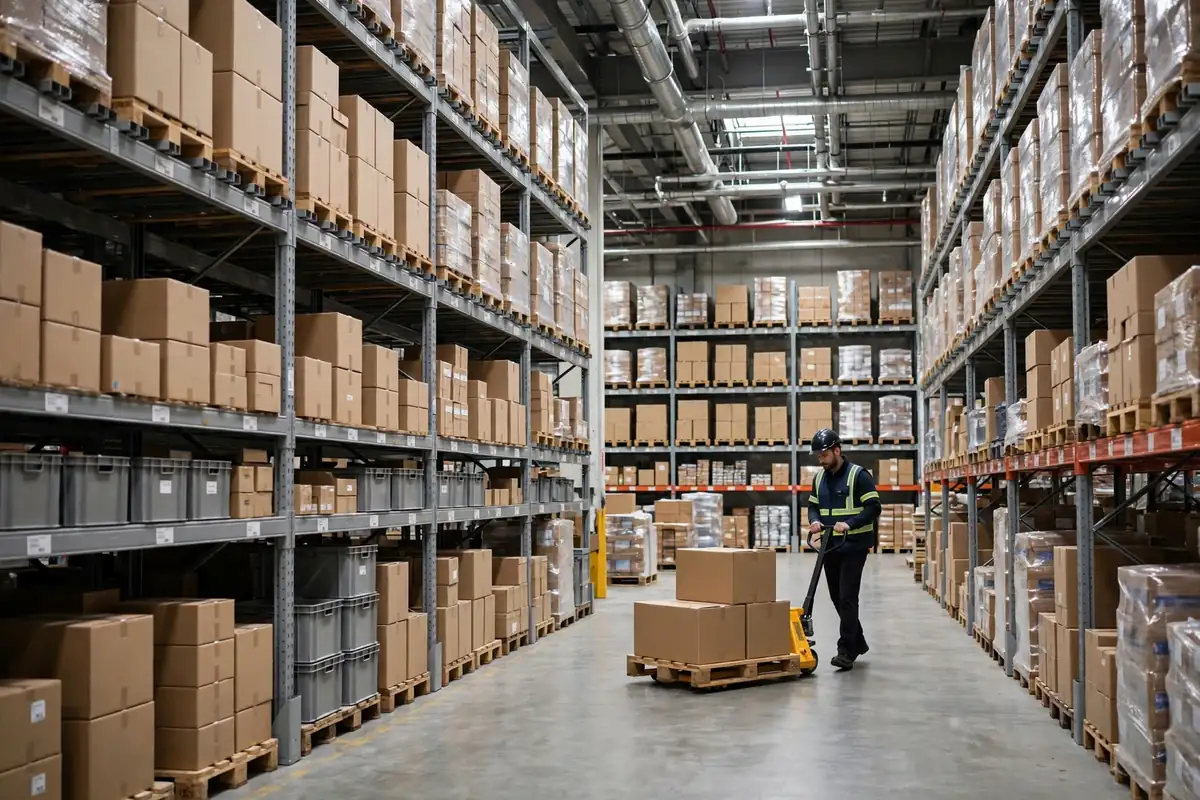
Yes, foreign workers can get warehouse jobs in Canada with LMIA sponsorship in 2026. Employers in Canada’s logistics sector, especially around Mississauga and the Greater Toronto Area, hire order pickers, packers and forklift operators all year, and when no local workers are available they can obtain a Labour Market Impact Assessment (LMIA) to hire from abroad. This guide covers real 2026 pay rates, daily duties, shift patterns, physical requirements, forklift certification rules, the LMIA work permit route and safe steps to apply from your home country.
Job Overview: What Warehouse Workers Do in Canada
Warehouse workers keep Canada’s supply chain moving. Every online order, grocery shipment and retail delivery passes through a distribution center where people receive goods, store them, pick orders and load trucks. Canada’s e-commerce growth and busy retail seasons have kept demand for warehouse staff strong, and the Greater Toronto Area is the country’s biggest logistics corridor, with Mississauga sitting at its center near Toronto Pearson International Airport and the Highway 401 warehouse belt.
On the Government of Canada Job Bank, these occupations are grouped under NOC 75101 (material handlers), which covers warehouse workers, order pickers, packers, forklift operators and freight handlers. Related inventory and stock control roles fall under NOC 14403 (purchasing and inventory control workers). These codes matter because LMIA applications and work permits reference them, so you will see them on official paperwork. If you enjoy fast-paced, hands-on logistics work, you may also want to read our guide to sortation center warehouse associate jobs in Canada, a closely related role in the same distribution centers.
Common Warehouse Roles Foreign Workers Can Target
Not every warehouse job is identical. These are the four roles most often advertised in the GTA, with the skills each one needs.
1. Order Picker
Order pickers walk or ride through the warehouse aisles, locate items from pick lists or handheld scanners, and prepare them for packing or shipping. It is the most common entry-level warehouse role and the one most frequently listed on the Job Bank. In Mississauga, order pickers earned an average of about CAD 20.75 per hour in mid-2026, according to Indeed salary data, and recent local postings advertised CAD 19 to CAD 22 per hour for reach truck and order picker operators.
2. Packer and General Warehouse Labourer
Packers wrap, box and label products, build pallets and keep packing stations stocked. General labourers load and unload trucks, move goods by hand or with basic equipment, and help with cleaning and organizing. These roles need no certification, only reliability and physical stamina. Average pay for general warehouse workers in Mississauga was about CAD 20.50 per hour in mid-2026, with entry-level postings starting near CAD 17 to CAD 18 per hour.
3. Forklift Operator
Forklift operators drive counterbalance, reach or order picker forklifts to move pallets, load trailers and stack inventory. This is the best-paid warehouse floor role. Recent Mississauga postings in October 2026 advertised CAD 20 to CAD 26 per hour for certified operators, with experienced counterbalance drivers at the top of that range. You need valid forklift training for the equipment type used on site, and most employers test your skills in person before you start. Certified machine operators may also want to compare experienced operator jobs in Canada with visa sponsorship, which cover similar equipment skills in other industries.
4. Shipper and Receiver
Shipping and receiving staff check incoming deliveries against purchase orders, inspect for damage, enter stock into inventory systems and prepare outbound shipments with the right paperwork. It suits workers who are organized and comfortable with basic computer systems, and it often pays slightly above general labour rates.
Typical Duties of a Warehouse Worker
Day-to-day tasks are consistent across most facilities. Based on current Job Bank postings, expect a mix of the following:
- Load, unload and move products and materials by hand or with basic material handling equipment
- Pick orders and stock from shelves using pick sheets or RF scanners
- Pack, wrap, label and palletize goods for shipment
- Sort, crate and stack goods in assigned storage locations
- Operate forklifts, pallet jacks or order pickers where certified
- Weigh materials, make labels and attach them to goods
- Organize and maintain inventory and keep aisles clear and safe
- Follow health and safety procedures, including wearing steel-toed boots and other protective gear
Shift Patterns and Work Hours
Warehouses run on shifts, and flexibility helps your application. Most distribution centers operate day, afternoon and night shifts, with common patterns of 8-hour or 10-hour shifts. Recent Mississauga postings in 2026 advertised schedules such as Monday to Friday, 8:00 am to 4:30 pm, and part-time evening shifts such as 6:30 pm to 10:30 pm. Full-time roles are generally 40 hours per week, and overtime is common during peak retail periods such as the holiday season.
Many warehouse positions start as temp-to-hire through staffing agencies, which means you work a probation period before becoming a permanent employee with benefits. This is normal in the industry and can still lead to LMIA-supported hiring when the employer decides to keep you long term.
Requirements for Warehouse Jobs in Canada
Warehouse work is genuinely entry level, but employers still screen for a few essentials:
- Age: you must be at least 18 years old for most warehouse and forklift roles.
- Education: most postings ask for a high school diploma or less, and some list no education requirement at all.
- Language: basic English is needed to read safety signs, follow instructions and communicate with the team.
- Physical fitness: expect long periods of standing and walking, bending, crouching and kneeling. Job Bank postings commonly list lifting requirements of up to 45 kg (100 lbs), with many roles in the 50 lb range.
- Safety gear: you will need CSA-approved steel-toed safety boots, and employers supply other protective equipment.
- Forklift certification: for operator roles only. Ontario does not issue government forklift licences. Instead, the employer must make sure operators are trained to the CSA B335-15 standard and can demonstrate competency on the specific equipment. Certificates are typically renewed every three years, and no regular driver’s licence is required.
- Background checks: some employers ask for a criminal record check before hiring.
Warehouse work is one of the more accessible paths for newcomers, alongside other physically demanding entry-level options such as steel plant labourer jobs in Canada.
Warehouse Worker Salary in Canada in 2026
Pay varies by role, certification and shift, but 2026 data for the Mississauga area gives a clear picture:
- Order pickers: about CAD 20.75 per hour on average in mid-2026 (Indeed), with most postings in the CAD 19 to CAD 22 range.
- General warehouse workers: about CAD 20.50 per hour on average (Indeed), with entry-level roles starting around CAD 17 to CAD 18 per hour.
- Warehouse associates: PayScale reported an average of about CAD 17 per hour in Mississauga in 2026, which reflects the lower end for new hires.
- Forklift operators: CAD 20 to CAD 26 per hour in recent Mississauga postings, with certified counterbalance and reach operators earning the most.
Overall, expect roughly CAD 17 to CAD 26 per hour in the GTA in 2026, which works out to about CAD 35,000 to CAD 54,000 per year for full-time work. Many employers add night shift premiums, overtime pay and health benefits after a probation period, and temp-to-hire postings commonly note that benefits begin once you convert to permanent status.
Where LMIA Warehouses Hire in Canada
Mississauga, Ontario is the suggested focus for good reason. It is one of Canada’s largest warehousing and distribution hubs, with dense industrial parks along the Highway 401, Dixie Road and Airport Road corridors, minutes from Toronto Pearson International Airport. Brampton, Etobicoke and Milton host major facilities too, and the Job Bank regularly lists warehouse postings across Ontario, Alberta and British Columbia.
The largest operations include Amazon fulfillment centers, Walmart and Loblaws distribution centers, Costco depots and courier networks such as DHL, UPS and FedEx. These employers advertise warehouse roles on the Job Bank and their own career pages. Always read the individual posting to confirm whether the employer is open to foreign workers or will support an LMIA, because sponsorship depends on the specific role and location, not the company name alone. Warehouse careers also pair naturally with driving work in the same supply chain, so also check truck driver jobs in Canada with LMIA if you hold a driving licence.
The LMIA and Work Permit Route, Explained
An LMIA (Labour Market Impact Assessment) is the document that lets a Canadian employer hire a foreign worker. Here is how the route works, step by step:
- The employer applies for the LMIA. The company submits an application to Employment and Social Development Canada (ESDC) showing it advertised the job in Canada and could not find a qualified local worker. The employer pays a CAD 1,000 processing fee. This fee is always paid by the employer, never by you.
- A positive LMIA is issued. This confirms hiring a foreign worker will have a neutral or positive effect on the Canadian labour market.
- You apply for a work permit. With the job offer letter and the LMIA number, you apply to Immigration, Refugees and Citizenship Canada (IRCC) for an employer-specific work permit. You will typically need a valid passport, a medical exam and a police clearance certificate, plus biometrics.
- You travel and start work. The work permit ties you to that employer and location, so you can only work the job named on the permit.
- Longer-term options. After gaining Canadian work experience, some workers explore permanent residence pathways. Eligibility rules change often, so check current IRCC guidance or a licensed immigration consultant before making plans.
How to Apply for Warehouse Jobs in Canada from Abroad
- Prepare a Canadian-style resume. Keep it to one or two pages, list your work history with dates, and leave out photos, age, religion and other personal details that Canadian resumes do not include.
- Search the Government of Canada Job Bank. It is the official source for verified postings and lets you see which employers indicate they will hire foreign candidates.
- Target LMIA-friendly postings. Look for phrases such as LMIA approved, LMIA available or foreign workers welcome in the job ad, and read the “who can apply” section carefully.
- Apply directly on employer career pages. Large distribution networks post openings on their own websites in addition to job boards, and direct applications avoid middlemen.
- Confirm sponsorship in writing. If you receive an offer, make sure the employer confirms it will apply for the LMIA and gives you a signed offer letter with the job title, wage, hours and location.
- Apply for your work permit through IRCC. Submit the offer letter and LMIA number, complete your medical exam and biometrics, and wait for a decision before booking travel.
- Never pay for the job. Read the scam warning below before you send money to anyone.
Scam Warning: Protect Yourself from LMIA Fraud
Warehouse and LMIA job scams target foreign applicants every year. Protect yourself with these rules:
- Legitimate employers never ask you to pay for a job offer or an LMIA. The CAD 1,000 LMIA processing fee is paid by the employer by law.
- No agent or consultant can guarantee your visa will be approved. Anyone promising a guaranteed work permit for a fee is not honest.
- Verify the company exists. Check the Job Bank posting, the company’s official website and independent reviews before sharing personal documents.
- Never send money by wire transfer, gift cards or cryptocurrency for supposed processing, training or accommodation fees.
- Be cautious of offers that arrive without an interview, wages far above market rates, or pressure to decide and pay immediately. Realistic warehouse pay in the GTA is CAD 17 to CAD 26 per hour in 2026, so offers far beyond that range deserve extra scrutiny.
Frequently Asked Questions
Can I get a warehouse job in Canada with no experience?
Yes. Order picker, packer and general labourer roles are entry-level positions, and many postings list no experience requirement or describe experience as an asset rather than a must. Employers value reliability, physical fitness and willingness to work shifts. Forklift operator roles are the exception, since they require valid equipment training.
Do I need a forklift licence before applying from abroad?
Not necessarily. Ontario has no government-issued forklift licence. Employers are responsible for training operators to the CSA B335-15 standard on the specific equipment used at their site, and many provide that training after hiring. Having a certificate already can strengthen your application, but general warehouse roles do not require one at all.
How much do warehouse workers earn in Canada in 2026?
In the Greater Toronto Area, general warehouse workers and order pickers earn roughly CAD 17 to CAD 22 per hour, with Indeed reporting mid-2026 averages near CAD 20.50 per hour in Mississauga. Certified forklift operators earn more, typically CAD 20 to CAD 26 per hour.
How long does the LMIA and work permit process take?
Timelines vary widely. LMIA processing by ESDC can take several weeks to a few months, and IRCC work permit processing times differ by country and change over time. Check the current published processing times on the official IRCC website rather than relying on any agent’s promise, and do not book non-refundable travel until your permit is approved.
Can warehouse jobs in Canada lead to permanent residence?
Possibly, but it depends on the immigration program and its current rules. Canadian work experience can support some permanent residence applications, while other programs require skilled-level occupations. Confirm your options against current IRCC guidance or through a licensed Canadian immigration consultant.
Do I need IELTS for a warehouse job with LMIA?
There is no general IELTS requirement for an LMIA-based work permit itself, though basic English is needed to work safely in a warehouse. Some immigration pathways and some employers may ask for language test results, so read the specific job posting and permit requirements rather than assuming.
Final Thoughts
Warehouse worker jobs in Canada with LMIA sponsorship remain one of the most realistic routes for foreign workers entering the Canadian job market in 2026. The work is physical and the shifts can be demanding, but the barrier to entry is low, pay in the GTA is solid at CAD 17 to CAD 26 per hour, and large distribution hubs around Mississauga hire continuously. Focus your search on the official Job Bank, confirm LMIA support in writing before you commit, and never pay anyone for a job offer. Done carefully, a warehouse role can be your first step toward a longer career in Canada’s logistics industry.
Can I get a warehouse job in Canada with no experience?
Yes. Order picker, packer and general labourer roles are entry-level positions, and many postings list no experience requirement. Employers value reliability, physical fitness and willingness to work shifts. Forklift operator roles are the exception, since they require valid equipment training.
Do I need a forklift licence before applying from abroad?
Not necessarily. Ontario has no government-issued forklift licence. Employers are responsible for training operators to the CSA B335-15 standard on the specific equipment used at their site, and many provide that training after hiring. Having a certificate already can strengthen your application, but general warehouse roles do not require one at all.
How much do warehouse workers earn in Canada in 2026?
In the Greater Toronto Area, general warehouse workers and order pickers earn roughly CAD 17 to CAD 22 per hour, with Indeed reporting mid-2026 averages near CAD 20.50 per hour in Mississauga. Certified forklift operators earn more, typically CAD 20 to CAD 26 per hour.
How long does the LMIA and work permit process take?
Timelines vary widely. LMIA processing by ESDC can take several weeks to a few months, and IRCC work permit processing times differ by country and change over time. Check the current published processing times on the official IRCC website, and do not book non-refundable travel until your permit is approved.
Can warehouse jobs in Canada lead to permanent residence?
Possibly, but it depends on the immigration program and its current rules. Canadian work experience can support some permanent residence applications, while other programs require skilled-level occupations. Confirm your options against current IRCC guidance or through a licensed Canadian immigration consultant.
Do I need IELTS for a warehouse job with LMIA?
There is no general IELTS requirement for an LMIA-based work permit itself, though basic English is needed to work safely in a warehouse. Some immigration pathways and some employers may ask for language test results, so read the specific job posting and permit requirements rather than assuming.