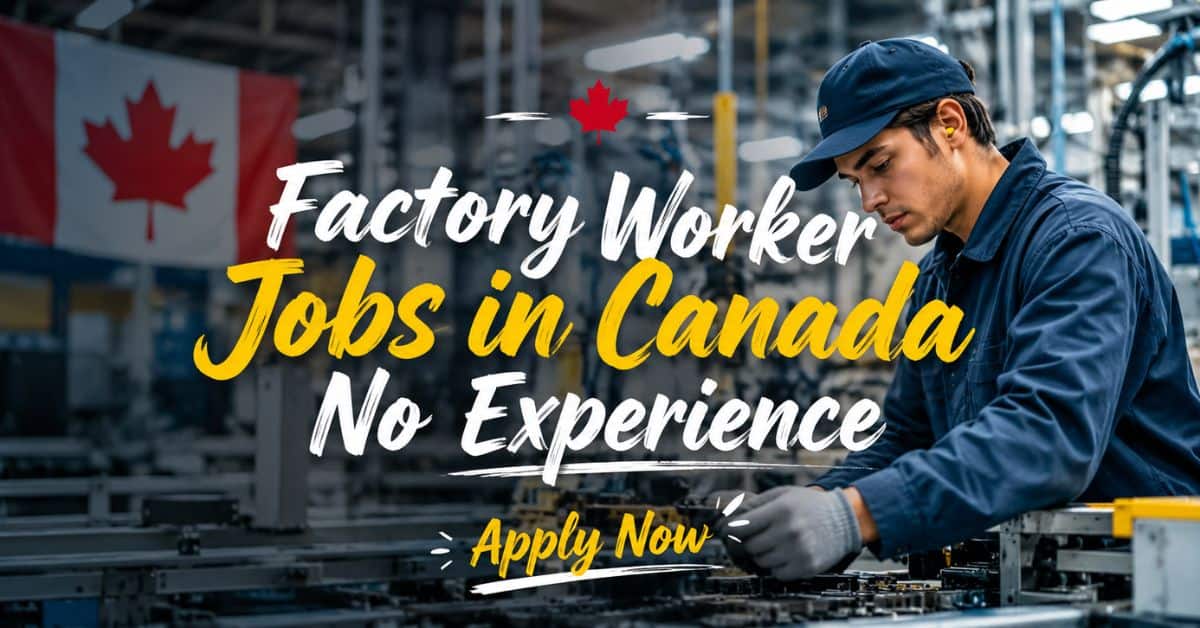
Factory Worker Jobs in Canada offer an average pay of $17 to $30 per hour, require no prior experience, are fully physical on-site roles in manufacturing and production facilities, and include entry-level to skilled production positions. For many people starting fresh in Canada, these jobs bring a sense of stability, routine, and the comfort of knowing that a steady paycheck is within reach, even without a long resume.
What Are Factory Worker Jobs in Canada?
Factory workers, also known as manufacturing or production workers, operate in facilities that manufacture commodities such as food, beverages, automotive parts, electronics, apparel, pharmaceuticals, and more. Typical tasks include product assembly, mechanical operation, packaging, quality inspection, sorting, and loading. These positions are referred to as “entry-level” because most employers provide extensive on-the-job training, rendering prior experience superfluous.
Factory labour in Canada is classified under the National Occupational Classification (NOC) system, namely codes 94 and 95, which include industrial butchers, assemblers, workers, and machine operators. These are some of the most in-demand sectors for both domestic job seekers and international workers via immigration routes.
Why Is Canada Hiring Factory Workers?
Canada’s manufacturing industry provides more than $174 billion to the national GDP each year. In 2026, numerous converging causes will drive record demand for factory workers:
- Ageing workforce retirement: A sizable section of Canada’s factory workforce is retiring, resulting in widespread job openings across the country.
- Reshoring after the epidemic: Canadian companies are bringing production back onshore, reducing reliance on overseas supply chains that were interrupted during the pandemic.
- Infrastructure investment: The federal government’s spending on domestic production, housing, and renewable energy has boosted demand for manufactured components.
- Population growth: Canada’s rapidly growing population, now reaching 41 million, is driving up domestic demand for consumer products.
Ontario, Alberta, British Columbia, Quebec, and Manitoba are among the top employing provinces, with Ontario’s Greater Toronto Area and the Windsor-Essex automotive corridor leading the way.
Types of Factory Worker Jobs in Canada No Experience:
Entry-level positions exist in a wide range of industries. The following is a breakdown of the most typically available roles in 2026:
- Working on a production line entails assembling or monitoring products as they move along a conveyor belt. There are no technical skills required; only concentration and the ability to work at a consistent rate.
- Packaging associates place finished products into boxes, bags, or containers. Typically done by hand or with basic gear. One of the most beginner-friendly positions accessible.
- Warehouse labourer: While theoretically related to factory employment, many warehouses tied to manufacturing plants employ workers for picking, packaging, and loading. Physical stamina is the primary prerequisite.
- Food processing workers can be found in meat packing plants, bakeries, and frozen food facilities. Handle, chop, wrap, or inspect food goods. These facilities hire heavily throughout the year.
- Quality control inspector (entry-level): Workers visually evaluate products for flaws. Employers provide training. Attention to detail is valued over technical knowledge.
- Forklift operator (trainable on-site): Many firms hire applicants with no prior forklift experience and offer certification training. Once accredited, this post often includes a wage increase.
- Machine operator trainees operate presses, cutters, or injection moulding machines after receiving full employer-led training. Many factories prefer to teach new employees from begin rather than retraining experienced workers with established practices.
Check Also: Farm Worker Jobs in Canada with Visa Sponsorship
Average Salaries for Factory Workers in Canada 2026:
Compensation varies according to province, industry, and shift pattern. This is a realistic overview based on current market data:
- Entry-level production workers earn $17 to $22 per hour. Experienced machine operator: $22 to $30 per hour. Forklift operator: $20 to $28 per hour. Food processing workers earn $17 – $23 per hour. Warehouse labourer: $17 to $21 per hour.
- Most manufacturing occupations pay 1.5 times the standard rate for overtime after 44 hours per week (in Ontario) or 8 hours per day (in British Columbia). Night and weekend assignments often pay a premium of $1 to $3 per hour over the regular wage.
- Canada’s federal minimum wage in 2026 is $17.30 per hour, while each province has its own minimum wage, with British Columbia currently leading at $17.40 per hour. No factory employer may legitimately pay below these levels.
Benefits:
- Steady Income and Overtime Pay: Factory jobs provide a reliable hourly wage, which helps workers manage monthly expenses with confidence. Many companies also offer overtime pay, allowing employees to earn extra when working beyond standard hours.
- No Experience Required with Full Training: One of the biggest advantages is that beginners can start without prior experience. Employers usually provide complete on-the-job training, making it easier for newcomers to learn and settle into the role.
- Health and Insurance Benefits: After completing the probation period, many factories offer health, dental, and basic insurance coverage. This support helps workers take care of their medical needs without heavy financial stress.
- Paid Leave and Holidays: Most factory jobs include paid vacation days and government-mandated holidays. This gives workers time to rest, spend time with family, and maintain a healthier work-life balance.
- Safety Equipment and Workplace Protection: Employers usually provide safety gear such as gloves, helmets, and protective clothing. Strict safety rules are followed to ensure workers are protected in the workplace.
- Fixed Shifts and Routine Schedule: Factories often run on set shifts like morning, evening, and night. This predictable schedule helps workers plan their daily life and maintain a stable routine.
- Career Growth Opportunities: Many workers start in entry-level roles and gradually move into positions like machine operator, team lead, or supervisor. Hard work and consistency can lead to long-term career development.
- Job Security in a Growing Industry: Manufacturing continues to grow in Canada, creating steady demand for workers. This makes factory jobs more secure compared to many other entry-level roles.
- Retirement and Pension Benefits: In many full-time positions, employers contribute to pension plans like the CPP. This helps workers build financial security for the future.
- Immigration and Settlement Opportunities: For eligible foreign workers, factory jobs can support pathways to permanent residency through various immigration programs, making it a strong starting point for building a life in Canada.
Who Can Apply?
One of the most significant advantages of manufacturing worker jobs is the minimal eligibility requirement. Here’s who qualifies:
- Canadian nationals and permanent residents are immediately entitled to apply for any factory position.
- Many manufacturers engage in the Temporary Foreign Workers Program (TFWP). Employers can use the low-wage stream to hire international workers when they are unable to fill local employment.
- International students: Those with a valid study permit and co-op authorisation may work in manufacturing. Open work permit holders may work for any employer.
- Newcomers with work permits: Refugees, protected persons, and other work permit holders are typically eligible.
- Most factory jobs, especially those involving machinery, need a minimum age of 18 years. Some light assembly positions accept workers aged 16 and up with parental approval.
- Physical requirements: Working in a factory can be physically demanding. Most job advertisements require the ability to lift 20-50 pounds, stand for extended periods of time (6-10 hours), and work in either warm or cold conditions, depending on the facility.
- Language: Basic English or French communication skills are frequently necessary for safety briefings. However, many manufacturers in major cities such as Brampton, Mississauga, and Laval employ multilingual workers and supervisors.
How to Write a Resume for a Factory Job With No Experience?
A competitive resume does not require previous factory work experience. Focus on the following:
Begin with a clear objective statement that emphasises your dependability, physical capability, and eagerness to learn. List any transferable talents, such as customer service, retail stocking, construction labour, or athletic training, which all demonstrate relevant physical and teamwork ability. Include any certifications you have, even if they are not related to manufacturing first aid, WHMIS (Workplace Hazardous Materials Information System), or a forklift licence would immediately improve your application.
WHMIS certification is free or low-cost online, and it takes about two hours to complete. Many employers require it or consider it highly. You can get it from sites like whmis.net or the Canadian Centre for Occupational Health and Safety (CCOHS).
Keep your resume to a single page. Factory hiring managers review dozens of applications per day; a clean, scannable structure with bullet points, your contact information, and availability is all that is required.
What to Expect on the Job?
Understanding the realities of factory labour will help you succeed from day one.
Shift structures: Most factories run two or three shifts that last 24 hours. Common schedules are 7 AM – 3 PM (day), 3 PM – 11 PM (afternoon), and 11 PM – 7 AM (evening). Rotating shifts, which alternate between the day and night cycles, are also prevalent. Some facilities provide straight-day shifts, which are more challenging to get.
Most organisations use a 90-day probationary term. This is your opportunity to display dependability, timeliness, and a pleasant attitude. Employees who show up consistently and communicate effectively are almost usually retained.
Canadian manufacturers are subject to federal and provincial occupational health and safety rules. You have the legal right to know about hazards, to participate in safety practices, and to refuse risky work. Do not hesitate to discuss safety issues with your supervisor or a health and safety representative.
Physical adaptation: The first few weeks can be exhausting as your body gets used to standing, repetitive action, and the factory atmosphere. Invest in decent steel-toed boots (often required), eat well, and remain hydrated.
Immigration Pathways for Factory Workers to Stay in Canada:
If you are a temporary foreign worker looking for permanent residency, manufacturing labour can be a clear road.
Workers in skilled manufacturing professions (NOC codes 72, 73, 82, 83, and 92) may be eligible for Canada’s Federal Skilled Trades Program through Express Entry, which leads to permanent residency.
Provincial Nominee Programs (PNPs): Each province has a stream dedicated to nominating workers for in-demand jobs. Manufacturing vocations are frequently included in Saskatchewan’s In-Demand stream, the Manitoba Provincial Nominee Program, and the Ontario Immigrant Nominee Program.
Temporary Resident to Permanent Resident road: As announced by Immigration, Refugees, and Citizenship Canada (IRCC), this road permits important workers, particularly those in food processing and manufacturing, to apply for permanent residency after working in Canada for at least a year.
Workers’ Rights You Must Know:
Canada has strong labour rules that safeguard factory workers. These rights safeguard every worker, regardless of immigration status.
You are entitled to a safe workplace free of known hazards. You must receive at least the provincial minimum pay. Beyond the legal thresholds, overtime must be paid at 1.5 times your usual rate. You are entitled to breaks, including a 30-minute unpaid meal break after 5 hours of work. You cannot be fired for submitting a workplace safety complaint. You have the right to join a union.
If you are a victim of workplace infractions, you can register a complaint with your provincial Ministry of Labour for free, and you will be protected from reprisal.
Top Companies Hiring Factory Workers in Canada Right Now:
The following employers have maintained consistent hiring across 2025 and into 2026:
- Maple Leaf Foods operates food processing facilities across Ontario, Manitoba, and Alberta. They hire continuously for production, sanitation, and packaging roles.
- Magna International is one of Canada’s largest automotive parts manufacturers, with facilities in Ontario. They train entry-level workers and promote from within.
- Amazon Fulfilment Centres across Ontario, British Columbia, and Alberta hire warehouse associates and packing staff with no experience required.
- Cargill Canada operates grain, poultry, and beef processing facilities and hires heavily in Alberta and Ontario.
- Saputo Inc. is a major dairy products manufacturer with facilities in Quebec, Ontario, and British Columbia.
- Lakeview Milling, Frito-Lay, Smucker Foods, and various contract packaging companies also post consistently on Job Bank and Indeed.
How to Find Factory Worker Jobs in Canada With No Experience?
- Job boards to use right now:
- Indeed.ca, Workopolis, Job Bank (the Canadian government’s official employment board, jobbank.gc.ca), LinkedIn, and Kijiji Jobs are the most successful sites for seeking manufacturing jobs in 2026. Search phrases such as “production worker no experience,” “general labour,” “entry level factory,” or “warehouse associate” can yield hundreds of live job posts.
- Staffing and temp agencies:
- This is one of the quickest routes to manufacturing work. Randstad Canada, Adecco, Manpower, and Workforce Inc. consistently put people in manufacturing within days after registration. Many manufacturing companies prefer to hire through agencies initially and then convert strong performers to permanent employees.
- Direct company applications:
- Large firms in Canada, such as Maple Leaf Foods, Magna International, Linamar, Amazon Fulfilment Centers, and Loblaws distribution facilities, list job positions directly on their websites. Applying directly can sometimes be faster than searching job boards.
- Newcomer settlement agencies:
- Organisations such as ACCES Employment, COSTI Immigrant Services, and Skills for Change (Ontario) offer job placement assistance exclusively for newcomers and connect candidates to manufacturing firms eager to diversify their workforce.
Conclusion:
Factory worker jobs in Canada offer stable, entry-level opportunities with no experience required, along with on-the-job training and competitive hourly pay. They are in high demand due to industry growth, labour shortages, and rising production needs across the country. For many workers, these roles provide a practical starting point that leads to financial stability and long-term career growth.
Frequently Asked Questions:
Do I need experience to get a factory job in Canada?
No, most factory jobs are entry-level and come with full-on-the-job training, so beginners can easily apply.
How much do factory workers earn in Canada?
Factory workers typically earn between $17 and $30 per hour, depending on the role, experience, and location.
Are factory jobs in Canada physical or remote?
Factory jobs are fully physical, on-site roles that involve standing, lifting, and working in production or warehouse environments.