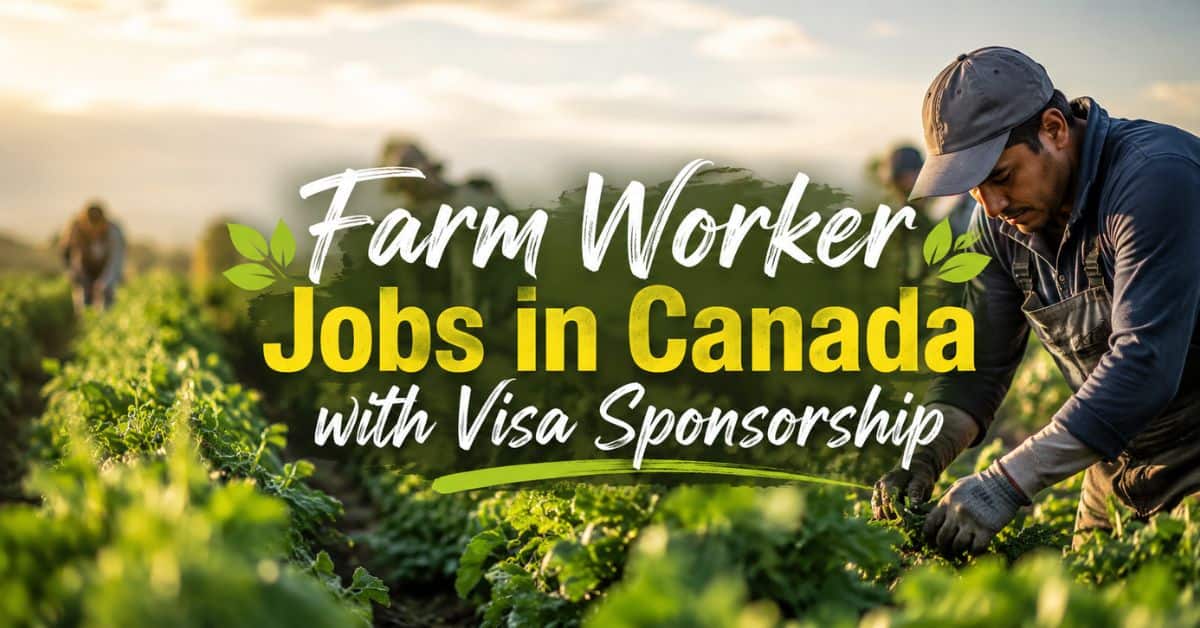
Farm work jobs in Canada offer a salary of around CAD $16 to $22 per hour, with experienced workers earning up to CAD $30+ per hour, depending on the role. Most positions require little to no formal experience, making them accessible to beginners who are physically fit and willing to learn.
These are fully physical, on-site jobs with no remote work options, covering roles like fruit picking, livestock care, greenhouse work, and machinery assistance in open fields and farms.
Overview of Farm Work in Canada:
Canada has around 193,000 farms covering more than 62 million acres of agricultural land. The country produces everything from wheat and canola to fruits, vegetables, and cattle, and it is significantly reliant on a consistent seasonal and year-round workforce to maintain production.
In 2026, labour shortages in the rural and agricultural industries will remain considerable. The Canadian government has responded by increasing visa sponsorship paths aimed primarily at bringing skilled and unskilled farm labourers from abroad. This means that if you are from Mexico, Jamaica, the Philippines, India, or anywhere else, you can work lawfully on Canadian farms through genuine, employer-sponsored channels.
Agriculture, agri-food, and agri-products contribute around $143 billion to Canada’s GDP each year. Farm labour shortages cost the industry an estimated $2.9 billion per year, making foreign worker recruitment not just acceptable but necessary.
Visa Sponsorship Programs for Farm Workers:
In 2026, three key government-backed schemes allow farm workers to enter Canada with full visa sponsorship. The most crucial first step is to determine which one relates to your specific situation.
- Seasonal Agricultural Worker Program (SAWP)
- Open to inhabitants of Mexico and 11 Caribbean countries. Work permits range from 8 weeks to 8 months. The employer offers accommodation, transportation, and medical care.
- Temporary Foreign Worker Program (TFWP)
- A broader agricultural stream open to workers from most countries. Employers must complete a Labour Market Impact Assessment (LMIA). Permits for up to two years are renewed.
- Agri-Food Immigration Pilot
- Experienced non-seasonal agricultural workers in businesses such as meat processing, mushroom cultivation, and greenhouse operations can get permanent residency.
- The SAWP is the most structured and popular program for seasonal farm work. The TFWP is more adaptable and encompasses a wider variety of responsibilities. The Agri-Food Pilot is appropriate if you want to eventually stay permanently in Canada.
Important: Be wary of third-party recruiters that charge fees. Employers or authorised recruiters in Canada are not permitted to charge placement or recruitment fees to employees. Always check employment offers with official government portals or recognised employer associations.
Benefits:
- Legal work authorization: You get a valid Canadian work permit through approved programs like SAWP or TFWP, ensuring safe and legal employment under Canadian labour laws.
- Stable income: Farm workers typically earn CAD $16–$22 per hour, with opportunities for overtime and seasonal bonuses that increase overall earnings.
- Free or low-cost accommodation: Many employers provide housing near farms, helping workers save more of their income instead of spending heavily on rent.
- Travel and transport support: Some programs cover round-trip airfare and daily transport between accommodation and the workplace, reducing relocation costs.
- Healthcare and protection: Workers are often covered by provincial health insurance and workplace safety regulations, ensuring medical and job security during employment.
- Pathway to future opportunities: Certain agricultural programs offer long-term prospects, including eligibility for permanent residency through specific immigration pathways.
- No high qualifications required: Most roles are entry-level and do not require formal education—basic fitness and willingness to work are usually enough.
- Seasonal flexibility: Jobs can last from a few weeks to several months, giving workers flexibility based on their personal and financial goals.
Types of Farm Worker Jobs in Canada with Visa Sponsorship:
Farm worker occupations in Canada in 2026 cover a wide range of tasks, skill levels, and sectors. Most jobs do not require a degree or formal schooling; instead, physical fitness, a desire to work outside, and related experience are most important.
- Fruit and Berry Picker: Strawberries, blueberries, apples, and cherries are harvested predominantly in British Columbia, Ontario, and Quebec. Peak season: June through October.
- Vegetable Harvester: Picking, sorting, and packing produce such as tomatoes, peppers, and cucumbers. Greenhouse and fieldwork positions are offered year-round in several provinces.
- Livestock Farm Worker: Caring for cattle, pigs, poultry, or sheep includes feeding, cleaning, and monitoring their health. Year-round demand, particularly in Alberta and Manitoba.
- Greenhouse Worker: Caring for plants in controlled conditions. It is common to include planting, pruning, pest control, and packing. Indoor job with more consistent year-round hours.
- Grain Farm Labourer: Operating machinery, planting and harvesting wheat, canola, and barley. Prairie Provinces: Saskatchewan, Alberta, and Manitoba.
- Mushroom and Specialty Crop Worker: One of the categories eligible for permanent residency through the Agri-Food Immigration Pilot. High demand in British Columbia and Ontario.
Best Provinces Hiring Farm Workers:
Farm worker demand is spread across Canada, but certain provinces actively recruit more foreign workers due to the scale of their agricultural output and chronic labour gaps.
- British Columbia
- Ontario
- Alberta
- Saskatchewan
- Quebec
- Manitoba
- Nova Scotia
- Prince Edward Island
British Columbia is Canada’s most popular destination for fruit pickers, notably in the Okanagan Valley, which produces the majority of the country’s tree fruit and wine grapes. Ontario leads in greenhouse vegetable production and soft fruit growing, with the Niagara and Leamington regions experiencing the strongest demand. Alberta and Saskatchewan are grain and cattle hubs that need a year-round workforce. Quebec recruits substantially under the SAWP program, particularly for apple orchards and market gardens.
Check Also: LMIA-Approved Jobs in Canada for Pakistanis
Salary and Benefits You Can Expect:
Farm labourers’ wages in Canada are controlled, and they must reach or surpass the provincial minimum wage. In 2026, most farm labourers will earn between CAD $16 and $22 per hour, with experienced workers, machine operators, and supervisors earning much more.
| Job Role | Province | Hourly Wage (CAD) | Annual Estimate |
|---|---|---|---|
| Fruit / Berry Picker | British Columbia | $17 – $20 | $30,000 – $38,000 |
| Vegetable Harvester | Ontario | $17 – $21 | $32,000 – $40,000 |
| Greenhouse Worker | Ontario / BC | $18 – $23 | $35,000 – $45,000 |
| Livestock Farm Worker | Alberta | $18 – $25 | $38,000 – $50,000 |
| Grain Farm Operator | Saskatchewan | $20 – $28 | $42,000 – $55,000 |
| Farm Supervisor | Multiple | $24 – $32 | $48,000 – $65,000 |
Beyond wages, employer-sponsored positions under the SAWP and TFWP programs typically include accommodation, airport pickup on arrival, access to the provincial health insurance plan, and return airfare at the end of the contract.
Requirements to Qualify:
The eligibility criteria vary slightly depending on which program you apply through, but these are the core requirements shared across all farm worker visa sponsorship pathways in Canada in 2026.
- Valid Passport: Your passport must be valid for at least 6 months after your desired employment period in Canada.
- Job Offer Letter: A formal offer from a Canadian company that has obtained an approved LMIA or is registered with SAWP.
- Medical Examination: A medical check conducted by an IRCC-designated physician to validate your fitness to work in Canada.
- No Criminal Record: The application requires a clean police clearance certificate from your home country.
- Relevant Experience: While not usually required, having at least one season of farm work experience will considerably improve your application.
- Basic English or French: Sufficient communication skills to follow safety recommendations. High proficiency is rarely required for entry-level positions.
For workers applying under the SAWP, your nation of citizenship must be eligible in Canada (Mexico, Jamaica, Barbados, Trinidad and Tobago, Antigua and Barbuda, Dominica, Grenada, Montserrat, St. Kitts and Nevis, St. Lucia, or St. Vincent and the Grenadines).
How to Apply for Farm Worker Jobs in Canada with Visa Sponsorship?
Applying for a farm worker job in Canada with visa sponsorship in 2026 involves coordinating between a job offer, an employer application, and your own immigration application. Here is the full process broken down simply.
- Find a Sponsoring Employer
- Search on the Government of Canada’s Job Bank (jobbank.gc.ca), CanadaVisa.com, or through accredited recruitment agencies. Look specifically for listings marked “LMIA approved” or “SAWP.” Focus on farms with a history of hiring foreign workers.
- Receive a Formal Job Offer
- Once a Canadian employer agrees to hire you, they must issue you a formal offer letter. For TFWP positions, the employer will also provide you with an offer number tied to their LMIA approval.
- Gather Your Documents
- Collect your valid passport, the job offer letter, proof of agricultural work experience (reference letters or employment records), police clearance certificate, and passport-size photographs.
- Complete a Medical Examination
- Book an appointment with a panel physician in your country recognized by Immigration, Refugees and Citizenship Canada (IRCC). Results are submitted directly to IRCC electronically.
- 5. Apply for a Work Permit Online
- Submit your work permit application through the official IRCC portal at ircc.canada.ca. You will need your job offer details, LMIA number (if applicable), medical exam confirmation, and biometrics (if required for your country).
- Attend a Visa Interview (if required)
- Some countries require an in-person interview at a Canadian visa application centre. Check the IRCC website for your country’s requirements. Most applications are processed without an interview.
- Travel to Canada and Begin Work
- Once your work permit is approved, confirm your arrival date with your employer, arrange travel, and carry all original documents with you at the port of entry. A CBSA officer will issue your physical work permit on arrival.
Tips to Increase Your Chances:
- Tip 1: Apply early:
- Many Canadian farms start hiring for the summer and autumn seasons as early as January or February. Applications submitted before March have a substantially higher acceptance percentage, as jobs fill up quickly.
- Make your CV specifically for agriculture positions. Highlight any previous experience with specific crops, machinery (tractors, forklifts), irrigation systems, or livestock, even if it was informal or on a family farm. Employers in Canada favour specialisation above general labour experience.
- Tip 2: Use only official channels:
- Apply through jobbank.gc.ca or directly to farms and agricultural associations. Associations such as the British Columbia Agriculture Council, the Ontario Federation of Agriculture, and the Alberta Chicken Producers regularly post verified job postings and assist workers in connecting with respectable businesses.
- Include any agricultural training, food safety certification (such as FOODSAFE), or pesticide management courses in your resume. Even a simple online certification can set your application apart from hundreds of others.
- Tip 3: Be flexible about location and dates:
- Workers who indicate an openness to numerous provinces and are available for both the spring planting and autumn harvest seasons have a far bigger pool of employers to choose from.
- Finally, if you have previously worked in Canada under an agricultural program and returned to your home country in good standing, please state this explicitly. Return workers are usually prioritised by Canadian businesses and have a speedier, easier application procedure.
Frequently Asked Questions:
Can I bring my family to Canada on a farm worker visa?
Under the SAWP, you cannot bring family members during your work permit. Under some TFWP streams, your spouse may be eligible for an open work permit, and dependent children may be able to study. This depends on the NOC level of your position and the specific permit issued.
Does a farm worker job in Canada lead to permanent residency?
Yes, it can. The Agri-Food Immigration Pilot is specifically designed as a pathway to permanent residency for eligible agricultural workers. Additionally, work experience gained in Canada contributes to Canadian Experience Class (CEC) points under Express Entry, which can be used to apply for permanent residency over time.
How long does it take to get a farm worker work permit?
Processing times vary by country and program. Most TFWP work permit applications take between 4 to 8 weeks after submission if all documents are complete. SAWP applications coordinated through government liaison offices can sometimes be processed faster. Always apply at least 3 months before your intended start date.